|
|
Double barreled sporting gun |
|
This double barreled sporting gun is in almost original condition. The high number "675" and that it is cosigned with his son Pierre who died in 1815, indicates that it has been manufactured towards 1815. But Boutet seem to have cosigned with his deceased son also after his death in 1815 .

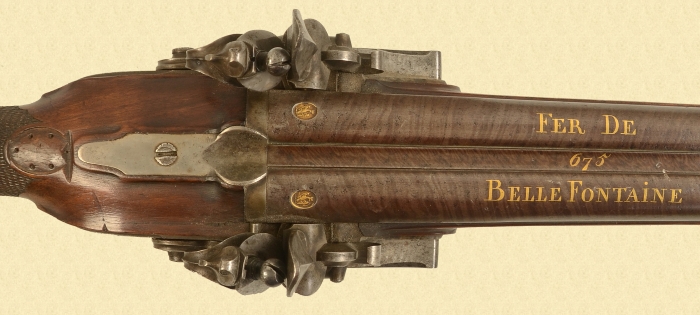
This double barrelled gun is marked with the number "675" between the barrels, and the inscription "FER De BELLEFONTAINE" in gilded letters on top of the damascened barrels. Both locks are engraved with "BOUTET et FILS a VERSAILLES", and there are one stamp on each barrel indication that the steel is from the Bellefontaine ironworks and forges.
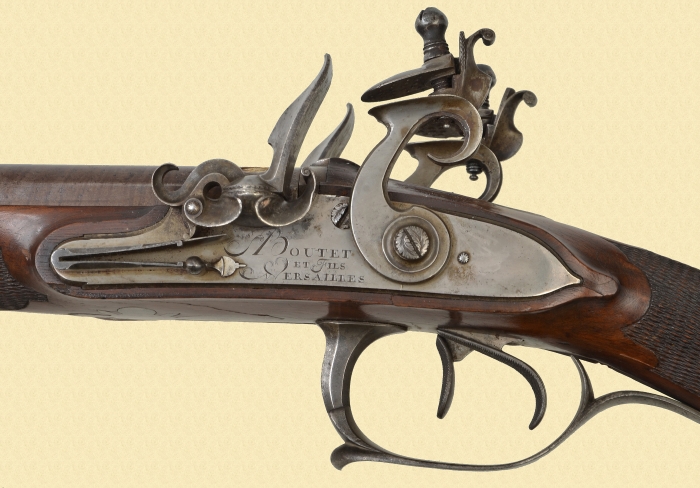
Some data on the gun: 60 Caliber; , mint bore, excellent stock, 34'' barrel, 95% blue. Made by Boutet circa 1814.Original condition. 90-95% original finish. No rust or restoration. Bores measure caliber 60, barrels are 34-inch long, overall length of the gun is 50-inch. Shows minor handling, but little or no signs of firing.
Boutet has cosigned this gun with his son Pierre-Nicolas Boutet, who was aged ca.25 around 1814 and had been working and learning with his father. Pierre-Nicolas Boutet was born on 2nd October 1789 and worked with his father in Versailles from 1804 at the age of 15. Within this period until the death of Pierre-Nicolas in 1816, Boutet signed select firearms Boutet et Fils.When Pierre died in 1816 Boutet continued cosigning with his deceased son. A younger brother Achile probably also received a formation as gunsmith, but he chose a career as Navy Officer.
The iron-and
steelworks “Les Forges de Bellefontaine” near Saint-Ursanne in the former
Prince-Bishopric of Basel, today in the canton of Jura, Switzerland., and was
an important iron and arms-producing establishment with roots back to 1563,
particularly during the period from approximately 1800 to 1830. More precisely
it was located near the Doubs River, close to the French border. A new blast
furnace was commissioned in 1757.
The works
used local iron ore, particularly from mines at Séprais, Courroux, and
other parts of the Delémont valley, as well as large quantities of
charcoal from the surrounding forests. Water power from the Doubs drove the
blowing apparatus, hammers, and other machinery.
The
purchase in 1797 was decisive for the development of the works. Pierre-François
Bornèque was the more prominent industrialist, while Jean-Georges Meiner had a
background in Audincourt. During the Consulate and Napoleonic period, Bornèque
supplied iron and other products to the imperial arms factories at Versailles
and Maubeuge.
The iron
produced at Bellefontaine had a good reputation. In 1806, the sub-prefect of
the arrondissement of Porrentruy recommended the products to the French
administration and sent samples to the “Exposition des produits de
l’industrie française in Paris”.
Bellefontaine
had a clear connection with arms production during the Napoleonic period. In
1793, the authorities of the département of Mont-Terrible decided that steel
from Bellefontaine should be forged into weapons, and its quality was tested
for arms manufacture.
The private owners, Meiner and
Bornèque modernised the works and connected them with French arms supplies,
while production reached at least approximately 350 tonnes of wrought iron
annually in 1813.
.
Please mail comments concerning this page and website to boutet @ armhis.com